
Scott County Probate Records
Probate in Scott County is a function of the Scott County District Court. Kansas probate law appears in Chapter 59, and the Kansas Probate Code uses the district court as the probate court for these matters. That means estates, wills, guardianships, conservatorships, and related protective matters are not routed to a separate county probate building.
The local filing and records point is the Clerk of the District Court at 303 Court Street, 2nd Floor, Scott City, KS 67871. The county page lists the court phone as (620) 260-2553. The 25th Judicial District directory lists Sandra Acosta as Clerk of the District Court and gives the clerk phone as (620) 260-2552. Posted hours are Monday through Friday, 8 a.m. to noon and 1 p.m. to 5 p.m.
Kansas probate authority comes from the Kansas Probate Code chapter index.
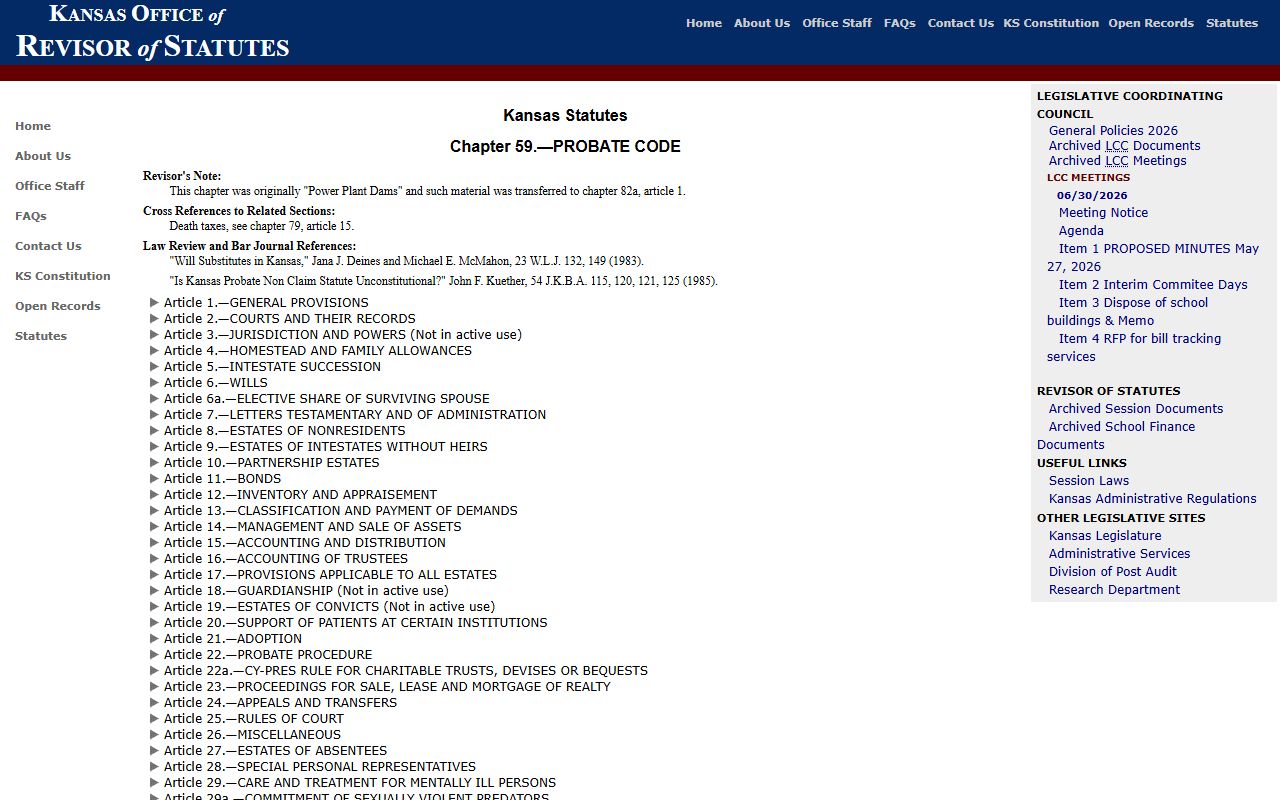
The state probate code supplies the legal framework, while the Scott County District Court supplies the local file and docket access point.
Scott County Probate Terms
Probate records use terms that are easy to confuse. These plain-language definitions help separate the person who died, the person managing the estate, and court-supervised roles for living people who need help with personal or financial decisions.
- Testator
- A person who made a will.
- Executor
- A person named to carry out a will after the court recognizes the authority.
- Intestate
- Dying without a valid will, which can require estate distribution under Kansas law.
- Guardianship
- A court process for authority over personal care decisions for a minor or adult.
- Conservatorship
- A court process for authority over another person's financial estate.
Search Scott County Probate Records
Public probate access starts with the same channels used for other Scott County District Court files. Use Kansas CaseSearch for public district court case information, the courthouse public access computer for in-office searches, or a direct clerk request when online results do not show the record or a certified copy is needed. The Scott County District Court policy page confirms public access computers, request methods, copy fees, and the three-business-day response window.
- Search CaseSearch by case number, party name, estate name, or other available criteria for Scott County District Court.
- Confirm the case type because probate, guardianship, conservatorship, and small-estate records can be grouped differently.
- Use the courthouse public access computer in the clerk's office if remote access is incomplete.
- Ask the Clerk of the District Court for copies by telephone, in person, in writing, or by fax.
- Plan for the local three-business-day response window and copy fees when records must be pulled or certified.
Note: Public docket entries do not mean every document in a probate or guardianship file is open to public inspection.
Scott County Probate Court
The probate court for Scott County is the Probate Division of the District Court. The local court is part of the 25th Judicial District, which also includes Finney, Greeley, Hamilton, Kearny, and Wichita counties. Probate filings should be directed to Scott County District Court when Scott County is the proper venue.
Scott County District Court
Probate Division of the District Court
303 Court Street, 2nd Floor
Scott City, KS 67871
(620) 260-2553
Monday-Friday, 8 a.m.-noon and 1 p.m.-5 p.m.
25th Judicial District Scott County
Clerk of the District Court: Sandra Acosta
303 Court Street
Scott City, KS 67871
(620) 260-2552
Scott County Probate Forms
The Kansas Judicial Council probate forms page is the official statewide starting point for many probate forms. It also indexes the small estates affidavit under K.S.A. 59-1507b. The forms are statewide, but filing questions, case numbers, copy requests, and local docket status belong with Scott County District Court.
Guardianship and conservatorship deserve special care. The Kansas Judicial Council guardianship page says Kansas made significant guardianship and conservatorship statute changes effective January 1, 2026. It groups forms for minors, adults, basic instructions, and reporting, and warns that additional documents may be needed. Judicial Council staff cannot give legal advice, recommend legal action, fill out forms, or interpret statutes.
Scott County Probate Fees
The available Scott County research located copy and certification fees from the District Court Clerk policy, but it did not locate a Scott County probate filing fee schedule. Filing-fee questions should be confirmed with the Clerk of the District Court before a petition is filed.
| Item | Amount | Source Note |
|---|---|---|
| District court copy fee | $0.25 per copy | Scott County District Court policy. |
| Additional certified copy | $1 | Scott County District Court policy. |
| Probate filing fee | Not located in Scott official sources | Confirm with the clerk before filing. |
| Small estate affidavit | Confirm if court filing applies | May be used outside full probate in some cases. |
Scott County Probate File Contents
Probate files can include wills admitted to probate, petitions for administration, petitions to admit a will, letters testamentary, letters of administration, inventories, appraisements, creditor claims, notices to creditors or heirs, court orders, accountings, receipts, and final settlement documents. Guardianship and conservatorship records may include petitions, annual reports, inventories and valuations, and protective arrangement orders.
| Record Type | What It May Show |
|---|---|
| Estate petition | Decedent, petitioner, requested authority, and estate type. |
| Will or petition to admit will | Testator, nominated executor, and request for court recognition. |
| Letters testamentary or administration | Authority granted to act for the estate. |
| Inventory or accounting | Estate property, values, receipts, payments, or distributions where public. |
| Guardianship report | Status information that may be limited because it concerns a protected person. |
Small Estates in Scott County
The Kansas Judicial Council small estates affidavit form is tied to K.S.A. 59-1507b. The research also found KDOR TR-83b small estate material referencing estates under $75,000 for certain personal property transfer situations. A small-estate affidavit is not a universal substitute for probate. Real estate, disputes, unclear heirs, creditor issues, or contested facts can still require a formal court process.
Before using a small-estate affidavit in Scott County, confirm whether the asset holder will accept the affidavit and whether court involvement is needed. The Clerk of the District Court can answer filing and records questions, but legal advice on estate strategy should come from a lawyer.
Restricted Probate Records
Routine estate docket entries and orders may be public, but probate records often contain sensitive material. Minors' information, medical details, incapacitated-adult information, protected addresses, financial account numbers, and sealed exhibits may be restricted or redacted. Kansas Open Records Act access rules also do not override court confidentiality rules for sealed or protected records.
The practical rule is to request the specific probate record needed and let the clerk identify whether it is public, redacted, requires party status, or needs a court order. If the record involves a minor, conservatorship accounting, medical proof, adoption-related material, or a sealed filing, expect limits.